First Nations & Colonial History
The Pre-history of Bondi Beach
There is some contention as to the origin of the word Bondi. One source suggests that "Bondi" or "Boondi" is an Aboriginal word meaning water breaking over rocks or noise of water breaking over rocks. While the Australian Museum records that Bondi means place where a flight of nullas took place.
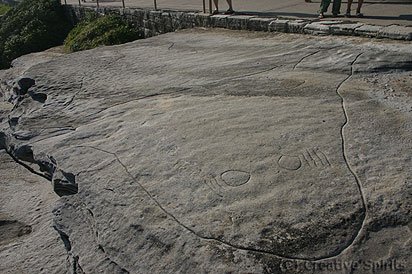
Aboriginal people occupied many sites in the area now known as Waverley in the period before European settlement. There were numerous recorded sightings during the early colonial period and there are significant Aboriginal rock carvings, including rough carving of fish or fishes on the cliffs on Ben Buckler, the Bondi Golf Course and MacKenzies Point. Early resident, Thomas O'Brien recalled finding Aboriginal remains and stone tomahawks after sand had been removed from the bay frontage after a gale.
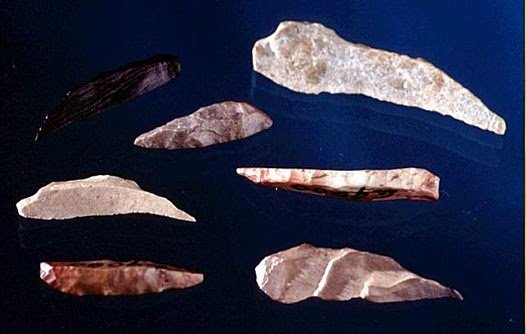
Ethnologists from the Australian Museum in Sydney have also found evidence among the stone implements and flint tools (most of them discarded as "faulty" by their ancient makers) of countless generations' of aboriginal craftsmen using the beach area as a large-scale tool-making facility, using materials chipped and fractured from the volcanic trench and other rocks nearby.
An important type of Aboriginal tool, the Bondi Point, was first identified in the Bondi area. The Bondi Point is usually less than 5 cm long and is sometimes described as a backed blade. Some examples suggest that the points were set in wooden handles or shafts. It occurs on coastal and inland sites across Australia, usually south of the Tropic of Capricorn. The oldest examples come from southeast Australia, dating from about 3000 BC, and the most recent are 300–500 years old.
The indigenous people of the area, at the time of European settlement, have generally been referred to as the Sydney people or the Eora. Eora means "the people". One theory describes the Eora as a sub-group of the Darug language group which occupied the Cumberland Plain west to the Blue Mountains. However, another theory suggests that they were a distinct language group of their own.
There is no clear evidence for the name or names of the particular band or bands of the Eora that roamed what is now the Waverley area. Most sources agree on the Cadigal but there are sources which name the Biddigal and Birrabirragal bands as well. A number of place names within Waverley, most famously Bondi, have been based on words derived from Aboriginal languages of the Sydney region.
European Settlement
Formal European settlement goes back to 1809, when the early road builder, William Roberts, in recognition of his laying out the Old South Head-road, received a grant of 81 hectares from Governor Bligh, of what is now most of the business and residential area of Bondi Beach.
From the mid-1800s Bondi Beach was a favourite location for family outings and picnics. In 1851, Edward Smith Hall and Francis O'Brien purchased 200 acres of the Bondi area that embraced almost the whole frontage of Bondi Beach, and it was named the "The Bondi Estate." Between 1855 and 1877 O'Brien purchased Hall's share of the land, renamed the land the "O'Brien Estate," and made the beach and the surrounding land available to the public as a picnic ground and amusement resort.
Access to Bondi Beach was made more convenient for Sydney residents by the introduction of bus services via the "Tea Gardens", named after the Tea Garden Hotel, situated at what is now Bondi Junction. People would then make their way to the beach via foot or by cart.
Local Government Established
Waverley was the second Sydney suburb to become a municipality. This happened on June 13, 1859, when Sir William Denison proclaimed the establishment of "The Municipality of Waverley". At one of its earliest meetings, in December 1859, the new Waverley Council divided the Municipality into three wards, naming them Bondi, Waverley and Nelson. Today those wards are named Bondi, Waverley, Hunter and Lawson.
As the beach became increasingly popular, O'Brien threatened to stop public beach access. However, it was not until June 9, 1882, that the NSW Government acted and Bondi Beach became a public beach.
The first tramway reached the beach in 1884 and the line was electrified in 1906. In 1926, Waverley Municipal Council introduced parking fees and timed parking due to the increased popularity of cars. The last tram to North Bondi and Bronte ran on Sunday 28th February, 1960.
Swimming at Bondi Beach
In the early 1800s swimming at Sydney's beaches was a controversial pastime. In 1803, Governor Philip King forbade convicts from bathing in Sydney Harbour because of "the dangers of sharks and stingrays, and for reasons of decorum". But by the 1830s sea bathing was becoming a popular activity, despite being officially banned between 9.00am and 8.00pm.
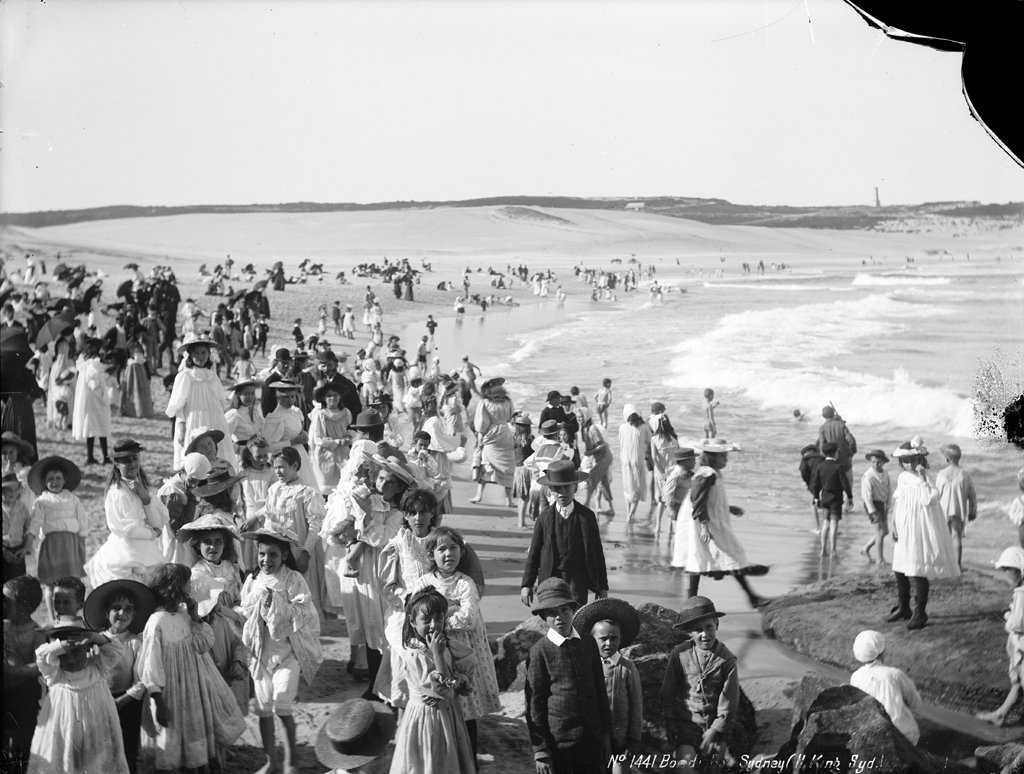
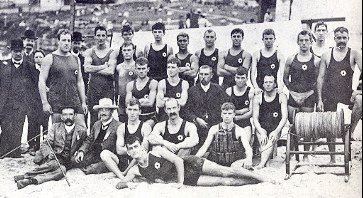
During the 1900s these restrictive attitudes began to relax and the beach became associated with health, leisure and democracy, a playground everyone could enjoy equally. In 1902 a man named Joe Gocher flouted Section 77 of the Police Offences Act which prohibited bathing between 9.00 a.m. and 8.00 p.m. Following this, sea bathing was allowed without fear of prosecution. As can be seen in the image below, at the turn of the century most people went picnicking at the beachside and seldom went swimming.
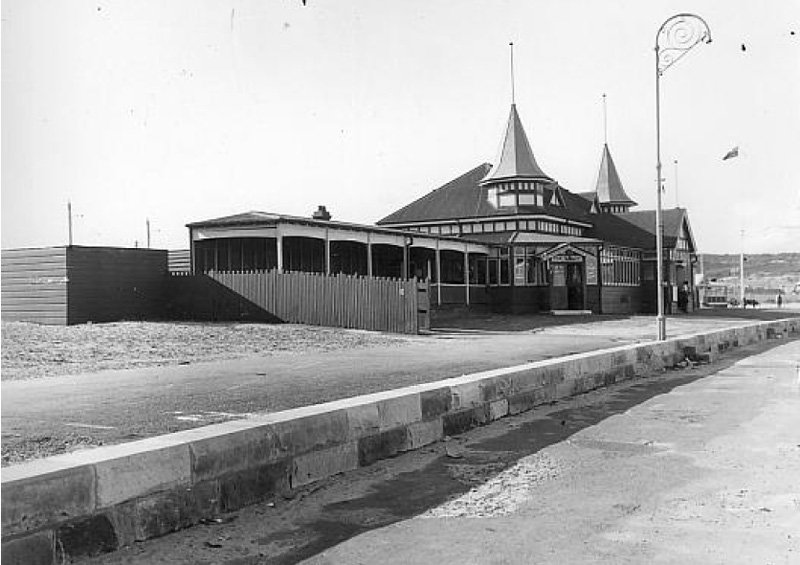
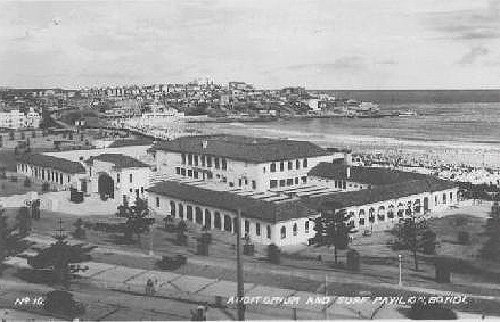
In 1905 Waverley Council agreed to the construction of two dressing rooms, one for men and one for women. In 1910 Waverley Council asked for tenders for a new structure and accepted a bid for £3,000 submitted by Taylor and Bills. The new sheds were completed in 1911 and were affectionately dubbed 'The Castle' or 'Castle Pavilion' in reference to the distinctive turrets.
In 1923 Waverley Council commenced the implementation of the Bondi Beach and Park Improvement Scheme. A competition was held to design the structures, which was won by the architectural firm of Robertson and Marks. The opening of the pavilion in 1929 attracted an estimated crowd of up to 200,000. The low-lying pavilion originally included a ballroom, a cabaret theatre, an auditorium, as well as Turkish baths and change rooms. By 1929 an average of 60,000 people were visiting the beach daily during summer weekends.
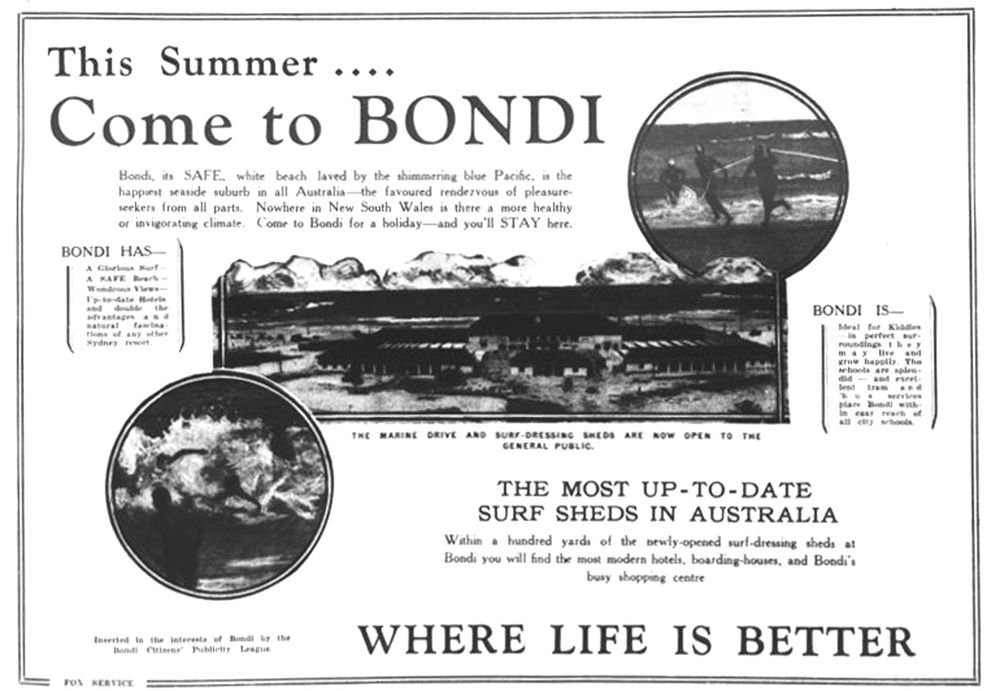
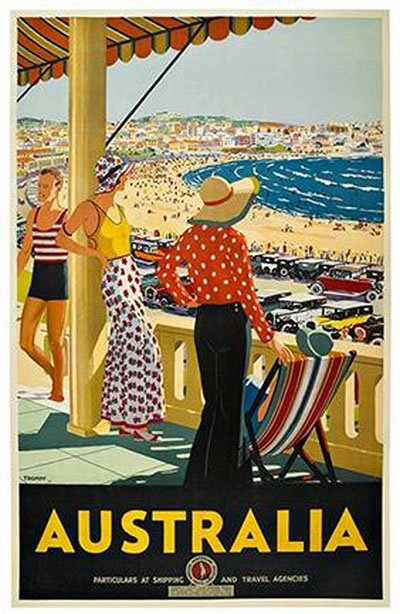
By the 1930s Bondi was drawing not only local visitors but also people from elsewhere in Australia and overseas. Advertising at the time referred to Bondi Beach as the "Playground of the Pacific".
Much of the residential development of Bondi Basin occurred during the 1920s in a period of rapid economic expansion following the restrictions of the First World War. Today, Bondi's housing stock reflects these beginnings. In the 2006 census, more than 70% of households in the Bondi area lived in a flat, unit or apartment.
The Bondi Pavilion was well utilised for about two decades after its opening. During the second world war, the first floor was requisitioned by the American Red Cross and the U.S. military to become an officers' club. After the war, dances were organised at the pavilion, and the proceeds went to disadvantaged Australian returned soldiers.
By the mid-1950s utilisation of the pavilion had begun to decline, as changes in bathing costumes from heavy material to nylon reduced the need for changing rooms. In an attempt to increase community participation, a theatre was opened in 1975 by Gough Whitlam. In 1978 the building was officially reopened as the Bondi Surf Pavilion Community Centre.
On 12th December 2015 Waverley Council announced that the pavilion would be reborn in a $40 million revamp as a state-of-the-art theatre and events space around a series of palm tree-dotted gardens. Architects Tonkin Zulaikha Greer have been selected for the long-awaited upgrade.
Bondi Beach was a working class suburb throughout most of the twentieth century. Following World War II, Bondi Beach and the Eastern Suburbs became popular with Jewish migrants from Poland, Russia, Hungary, Czechoslovakia and Germany. The area still has a number of synagogues and a kosher butcher.